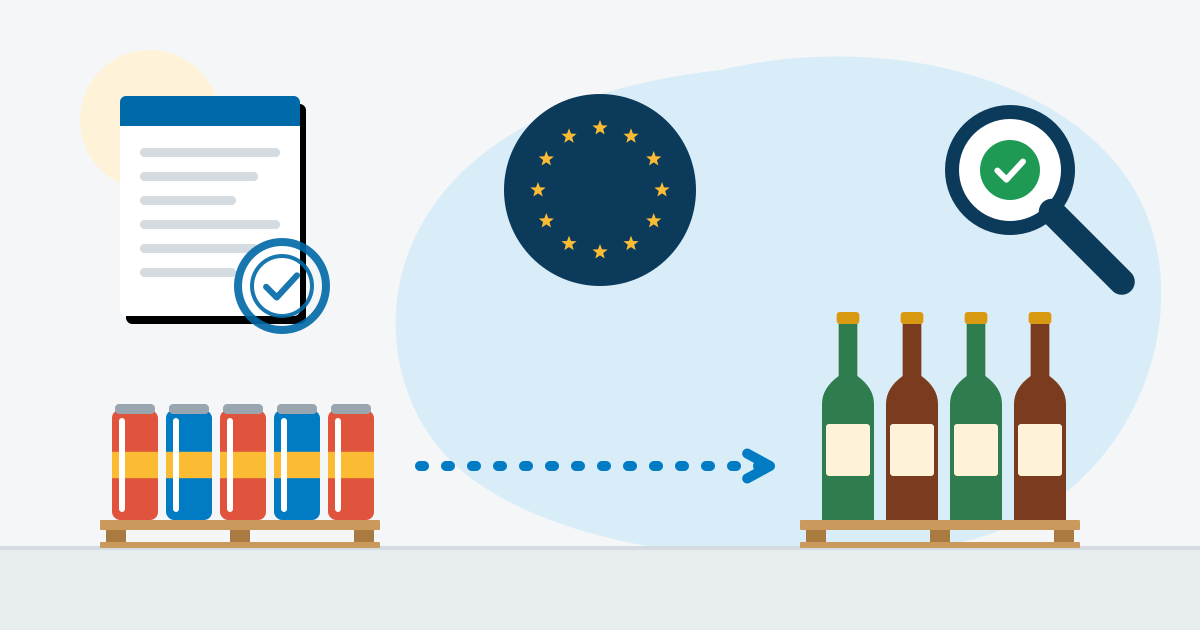
Buying branded drinks through parallel import: what to check before you order
Published 9 October 2026 · 8 min read · Buying
The same can of a well-known soft drink, energy drink or beer can cost noticeably different
amounts in different countries. Parallel trade — buying genuine branded goods in one market
and reselling them in another, outside the brand owner’s own distribution — exists
because of those gaps. Within the EU it is a normal, legal part of the wholesale trade. But it
comes with checks that buying from an official distributor does not: where the goods were first
sold, whose language is on the label, which deposit scheme the can belongs to, and whether the
product is really what the brand sells in your market.
General guidance, not legal advice. Trademark, labelling, excise and
deposit-scheme rules depend on the product and the destination country, and the details change.
Confirm how they apply to your goods with a qualified adviser or the relevant authority before
you buy.
Why parallel import is legal inside the EU — and where it stops
EU trade mark law follows the principle of exhaustion: once goods have been put on the
market in the European Economic Area (the EU plus Iceland, Liechtenstein and Norway) by the brand
owner or with its consent, the brand owner generally cannot use its trade mark to stop those same
goods being resold elsewhere in the EEA. That is what makes buying a pallet of a branded drink in
one member state and selling it in another possible.
The principle is regional, not worldwide. Goods first sold outside the EEA — for
example stock intended for a market in Asia, Africa or the Middle East — can usually only be
imported into the EEA with the brand owner’s consent. The EU Court of Justice has confirmed
this in several judgments. For a buyer, the most important question about any parallel stock is
therefore simple: where was it first placed on the market?
Typical situations in the parallel trade of branded drinks
Situation
General position
What to ask for
Goods sold in one EU country, resold into another EU country
Generally free to circulate under the exhaustion principle.
Invoices or other evidence showing EEA origin of the stock.
Goods made in the EU but sold first to a non-EEA market, then brought back
Usually needs the brand owner’s consent to re-enter the EEA.
Clarity on the original destination; be cautious without it.
Goods made and sold outside the EEA
Usually needs the brand owner’s consent to be imported.
Written evidence of consent, or buy from an authorised channel instead.
Goods with batch codes removed or labels altered
Can give the brand owner grounds to object even to EEA-origin goods.
Goods with original, intact coding and packaging.
Origin: what evidence to expect
A reliable seller should be able to tell you which market the stock was produced for and give
you documents that support it. In practice, buyers look at:
The label itself. Language, importer or distributor address, deposit marks
and the barcode prefix all hint at the market the goods were packed for. (A barcode prefix shows
where the code was issued, not where the product was made or sold, so treat it as a clue rather
than proof.)
Batch codes. They should be intact, readable and consistent across the
cartons. Scratched-off or over-labelled codes are a warning sign: brand owners use them to trace
distribution, and removing them can itself be a legal problem.
Commercial documents. The proforma
invoice, the final invoice and, for alcohol, the excise movement documents tell you who is
selling and from where. See the EU export
documents checklist for the full set.
Labelling: the pack must suit your market
Under EU food information rules, mandatory label information must appear in a language easily
understood by consumers in the country where the product is sold, and each member state can require
its own official language or languages. A drink packed for one country therefore often needs an
additional label before it can be sold in another. Over-stickering is common, but the sticker must
carry all the mandatory information, must not hide anything that has to stay visible, and becomes
the responsibility of whoever applies it.
Watch out for differences that a sticker cannot fix. The same brand is sometimes sold with a
different recipe, sweetener, alcohol strength, pack size or ingredients list in different
countries. If your customers expect the local version, compare the two packs before you order a
truck.
Excise, deposits and other drinks-specific checks
Alcohol is an excise product. Beer, wine and spirits moving between EU
countries travel either under duty suspension or with duty paid in the destination, and the
destination country’s tax marks may be required for spirits. Our guide to
excise duty suspension explains
the basics.
Deposit return schemes. Several EU countries charge a deposit on cans and
bottles, each with its own markings and registration rules. A can marked for one country’s
scheme may not be accepted in another’s, and the destination may require its own marking.
Check this early — it can decide whether a deal works at all.
Sugar and other levies. Some countries charge a levy on sweetened drinks or
impose their own rules on energy drinks and caffeine labelling. Factor any such costs into the
landed price.
Remaining shelf life. Parallel stock has often already passed through one
distributor. Agree a minimum remaining shelf life at delivery; see our guide to
best-before dates and remaining
shelf life.
Counterfeit and quality risk
Price gaps attract fraud as well as honest trade. Prices far below the market, sellers who will
not say where the goods came from, unfamiliar fonts or colours on the pack, and inconsistent batch
codes are all reasons to stop and ask questions. For a first order with a new supplier, many buyers
ask for photos of the actual pallets and batch codes, start with a smaller quantity, and arrange
an independent inspection before the balance is paid. Our guide to
paying a new
supplier covers how to structure payment.
What parallel stock does not come with
Buying outside the official channel usually means no listing support, promotional funding or
marketing from the brand owner, and no guarantee of continuous supply: availability depends on
price gaps that can close quickly when exchange rates or local prices change. Plan for it as
opportunistic stock rather than a permanent range, unless you have a reliable, repeat source.
What to tell us
Francoalva trades branded FMCG, including drinks. If you are looking for particular brands, tell
us the products, pack sizes, the destination country and the labelling your market requires. We
will tell you honestly what we can and cannot supply, and confirm any offer in writing —
including what you can expect on labels and documents.
Ordering a few pallets rather than a full truck: how groupage and part loads are priced, how to cut the cost per case, packing, transit times and paperwork.
Unit, case and pallet barcodes explained, what a 590 prefix really means, who owns a GTIN, and the product data sheet to request with every import order.
How an EU customs warehouse suspends import duty and VAT on non-EU goods, what handling is allowed, guarantees and records, and how re-export ends the procedure.