EAN barcodes and product data for imported FMCG: what to ask your wholesaler for
Published 26 October 2026 · 7 min read · Buying
When imported goods arrive, they have to go into your system before they can be sold: item
master, warehouse locations, till, webshop, and often a retailer’s supplier portal. Every one
of those needs barcodes and product data. Ask for it with the order and the stock goes on sale the
week it lands; chase it afterwards and pallets sit in the warehouse while someone measures cartons
by hand.
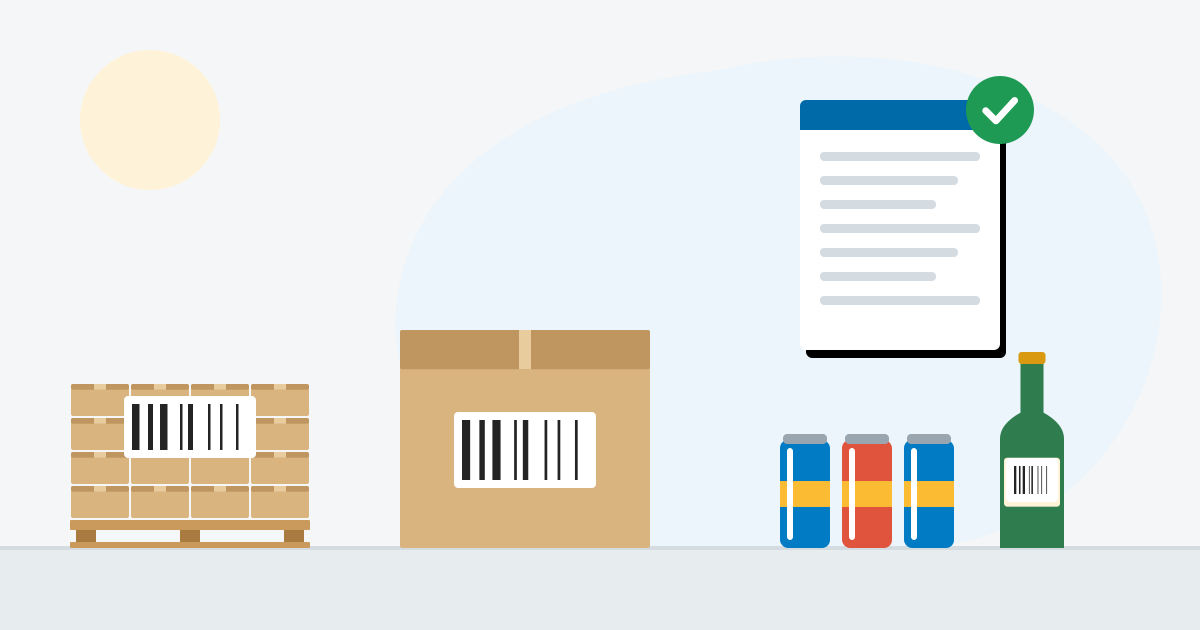
The three barcodes on an FMCG delivery
Barcodes used on consumer units, cases and pallets
Level
Usual barcode
What it identifies
Used by
Consumer unit (bottle, pack)
EAN-13 (GTIN-13)
The product as sold at the till.
Point of sale, webshop, shelf labels.
Case / outer carton
ITF-14 or EAN-13 (a separate GTIN)
The trade unit: a fixed number of consumer units.
Goods-in, warehouse picking, ordering.
Pallet
GS1-128 logistics label with an 18-digit SSCC
That one physical pallet in that shipment.
Receiving, track and trace, despatch advice.
The case code is not the consumer code: a 24-can tray and the single can inside it carry
different numbers. Mixing them up is the commonest reason a delivery “does not scan” at
goods-in.
Does a 590 prefix mean the product is Polish?
No. The first digits of an EAN-13 show which GS1 member organisation issued the number —
590 is GS1 Poland — not where the goods were made. A product made in Germany for a Polish
brand owner can carry 590; a product made in Poland for an Italian brand can carry an Italian
prefix. Country of origin comes from the label and the documents, not the barcode.
Who owns the barcode, and can you change it?
The GTIN belongs to the brand owner who licensed it from GS1. For branded goods, keep the
manufacturer’s barcode: covering it with your own sticker breaks the link to the
brand’s product data and can confuse retailers. If you need your own numbers — for a
private label range, for
example — you license them from the GS1 organisation in your own country. Local-language
stickers for labelling rules are a separate matter and should not hide the barcode.
The product data sheet to request with your order
Before the goods ship, ask for one row per line with at least:
Identification: product name, brand, consumer-unit EAN, case GTIN, and the
wholesaler’s item code.
Pack configuration: units per case, cases per layer, layers per pallet, pallet
type and full-pallet height — the figures that drive your
pallet and truck planning.
Dimensions and weights: net content, gross weight and dimensions of the unit,
the case and the full pallet.
Customs and tax data: the 8-digit CN (HS) code, country of origin, and for
drinks the alcohol strength and volume.
Food and cosmetics data: ingredients, allergens, nutrition or INCI list, and
storage conditions.
Images: a front-of-pack image in good resolution for your webshop or
catalogue.
Large retailers often want this through a GS1 data pool (GDSN) rather than a spreadsheet. If you
supply them, say so early; brand owners publish their data there, but a wholesaler can usually only
pass on what the brand provides.
Check barcodes before the balance is paid
Ask for photos of the case label and a consumer unit from the actual stock, and compare the
barcodes with your data sheet. It is the same logic as a
pre-shipment inspection: a variant
with a different EAN (a new recipe, another market’s pack) is much easier to fix before
loading than after.
What to tell us
Send the list of fields your system or your customer needs, in their format if you have one.
We will confirm in writing what we can supply for each line before you order.
Ordering a few pallets rather than a full truck: how groupage and part loads are priced, how to cut the cost per case, packing, transit times and paperwork.
How an EU customs warehouse suspends import duty and VAT on non-EU goods, what handling is allowed, guarantees and records, and how re-export ends the procedure.
What to check before you sign the CMR, how to write a reservation that holds up, the 7- and 21-day deadlines, the carrier's liability cap and what a claim needs.