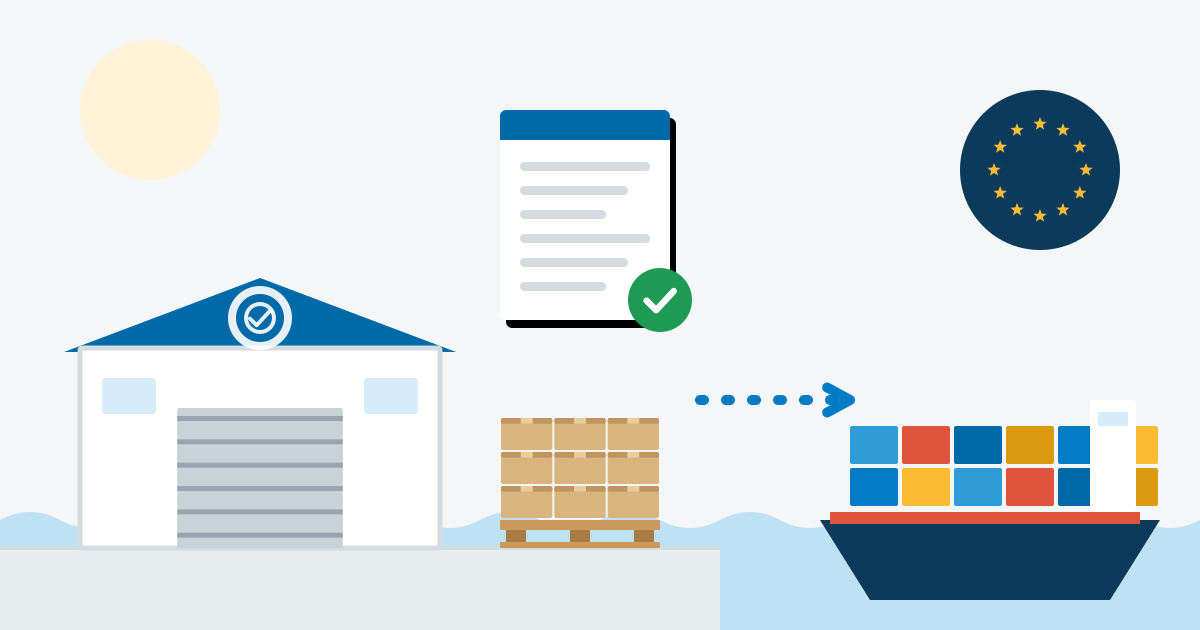
Buying goods for re-export: how customs warehousing keeps duty and VAT off non-EU stock
Published 24 October 2026 · 9 min read · Customs
Goods that arrive in the EU from outside it normally pay import duty and import VAT the moment
they are released for free circulation. If those goods are only passing through — bought in
one part of the world, held in Europe, then sold on to a buyer outside the EU — paying those
charges up front ties up cash for no reason. Customs warehousing exists to solve that. Non-EU goods
can be stored under customs supervision with duty and VAT suspended, and if they leave the EU
again, those charges are never paid at all.
General guidance, not legal or tax advice. Customs procedures depend on the
goods, their origin, the authorisation held by the warehouse and national practice, and the rules
change. Confirm how they apply to your shipment with a licensed customs agent or the customs
authority before you rely on them.
What a customs warehouse is
Under the Union Customs Code, customs warehousing is one of the EU’s “special
procedures” (it falls under storage, alongside free zones). It allows
non-Union goods — goods that have not been released for free circulation in
the EU — to be kept in premises approved by customs without import duty, import VAT or other
import charges becoming payable while they are there. The goods stay under customs control until
the procedure is ended.
The warehouse itself has to be authorised. In broad terms there are two kinds:
Public customs warehouses, run by a warehouse keeper (often a logistics or
forwarding company) and open to any trader who wants to store goods there.
Private customs warehouses, authorised for the holder’s own goods,
typically used by importers or traders with regular volumes.
A customs warehouse is not the same as an excise (tax) warehouse. Excise warehouses
suspend excise duty on alcohol, tobacco and energy products, whether those goods are EU or non-EU.
Beer or spirits can need both arrangements. Our guide to
excise duty suspension explains the
excise side.
Why buyers use it for re-export
How customs warehousing compares with importing straight away
Question
Released for free circulation on arrival
Placed in a customs warehouse
When are import duty and VAT paid?
At release, before the goods can be sold.
Only if and when the goods are later released for free circulation.
Goods re-exported outside the EU
Duty already paid; a refund, if available at all, needs a separate application.
No import duty or import VAT due on the re-exported goods.
Selling in small lots to different markets
All charges paid on the whole consignment at once.
Charges arise only on the part released into the EU; the rest can leave.
EU trade policy measures
Apply at release.
Generally apply when the goods are released, not while they are stored.
For a wholesale buyer the gain is mainly cash flow and flexibility: stock can wait close to
European ports and road routes while the final buyer, destination or price is settled, and each
part of the consignment is only charged according to where it finally goes.
How long goods can stay, and what can be done to them
The Union Customs Code sets no general time limit for customs warehousing,
although customs can set a deadline in particular cases, and the warehouse operator will charge
storage for every week the goods stay. Shelf life is usually the real limit for food and drinks
— see our guide to best-before
dates and remaining shelf life.
While the goods are stored, only usual forms of handling are allowed: operations that
preserve them, improve their appearance or marketable quality, or prepare them for distribution or
resale. Typical examples are sorting, repacking, splitting consignments, palletising and labelling.
Anything that turns them into a different product is processing, which needs a different procedure.
Some forms of handling need prior approval, so agree what you need with the warehouse keeper
before the goods arrive.
Guarantees, records and who is responsible
Guarantee. Because duty and VAT are suspended, customs normally requires a
guarantee covering the potential debt. In a public warehouse this is often arranged through the
warehouse keeper or your customs agent; the cost depends on the value and duty rate of the
goods.
Records. The authorisation holder must keep stock records that let customs
trace every movement into, within and out of the warehouse.
Responsibility. The holder of the authorisation and the holder of the
procedure (the person who placed the goods there) carry the obligations. If goods go missing or
a condition is broken, a customs debt can arise — so know which party you are in the
contract.
Documents. Commercial invoice, packing list, transport document and origin
evidence are still needed when the goods come in and when they leave. Our
EU export documents checklist lists
the usual set.
How the procedure ends
Goods leave customs warehousing in one of a few ways:
Re-export. The goods are declared for re-export and leave the EU customs
territory. No import duty or import VAT is charged on them. The exit is confirmed electronically,
and that confirmation is your evidence that the goods really left.
Release for free circulation. If you decide to sell the goods inside the EU
after all, they are declared for import and the duty and import VAT are paid then.
Another special procedure. Goods can move under transit to a port or another
warehouse, or into inward processing, without paying duty in between.
The Incoterm in the sale contract decides who arranges and pays for each of those steps. Our
guide to Incoterms for FMCG buyers covers
the options.
When customs warehousing is not the answer
The procedure is for non-Union goods. Products made in the EU, or goods already released for
free circulation, are EU goods: they move freely inside the EU and, when they are exported, VAT is
handled through the zero-rating rules explained in our guide to
VAT on exports from Poland, not through a
customs warehouse. For short-term holding at a port, temporary storage may be enough; for goods
that will be worked on, inward processing may suit better. A customs agent can say which procedure
fits your flow.
What to tell us
If you are planning a re-export flow, tell us the products, where they will come from, where
they are going and the Incoterm you have in mind. We will tell you what we can supply and on what
terms, and confirm it in writing. Payment for orders is by telegraphic transfer in EUR or USD, with
a deposit and the balance paid before release.
Ordering a few pallets rather than a full truck: how groupage and part loads are priced, how to cut the cost per case, packing, transit times and paperwork.
Unit, case and pallet barcodes explained, what a 590 prefix really means, who owns a GTIN, and the product data sheet to request with every import order.
What to check before you sign the CMR, how to write a reservation that holds up, the 7- and 21-day deadlines, the carrier's liability cap and what a claim needs.