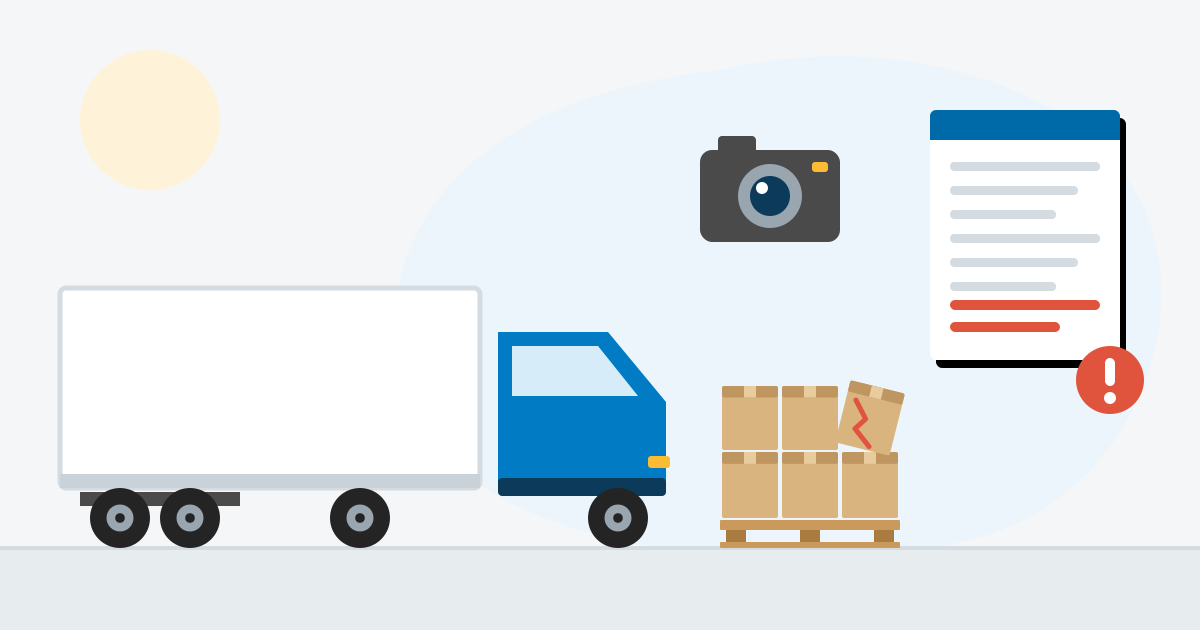
CMR damage claims: checking a wholesale delivery and claiming for loss or damage
Published 24 October 2026 · 9 min read · Logistics
Most problems with a pallet delivery are decided in the first half hour after the truck arrives.
A crushed corner, a broken stretch wrap or one pallet short is easy to prove while the driver is
still there and very hard to prove a week later. For international road freight in Europe the
rules that decide whether you can claim are set by the CMR Convention, and they reward buyers who
check the load and write their findings on the consignment note before signing.
General guidance, not legal advice. Which rules apply depends on the transport
contract, the route, national law and your insurance policy. For a significant claim, talk to
your insurer, freight forwarder or a transport lawyer early — deadlines are short.
When the CMR Convention applies
The CMR Convention governs contracts for the international carriage of goods by road for reward,
where the place where the carrier takes over the goods and the place of delivery are in two
different countries, at least one of which is a party to the Convention. All EU member states are
parties, as are many neighbouring countries. Purely domestic deliveries are usually covered by
national law instead, and sea and air freight have their own conventions with their own, often
shorter, notice periods.
The CMR consignment note (the “CMR”) is the key document. It records what the
carrier took over and in what condition, and the copy signed at delivery records what you
received. Our EU export documents
checklist shows where it sits among the other shipping papers.
Checking the delivery before you sign
Count the pallets against the CMR and the packing list, before unloading
starts if possible.
Check the seal on a sealed trailer or container: is it intact, and does the
number match the one on the documents?
Look at every pallet from all sides: torn or loose stretch wrap, crushed or
wet cartons, leaning stacks, broken pallet boards, leaking bottles or cans.
Take photos of the trailer as it is opened, of any damage before it is moved,
and of the truck’s registration plate.
For temperature-controlled loads, ask for the reefer unit’s temperature
printout and probe the product. Our guide to
temperature-controlled
transport explains what to look for.
If you sign a clean CMR, that signature is treated as evidence that you received the goods in the
condition and quantity described. You can still prove otherwise later, but the burden is on you.
If you see a problem, write a reservation on the consignment note before you sign,
and make sure the driver’s copy carries it too.
A useful reservation is specific: “pallet 4 of 22: stretch wrap torn, 6 cartons crushed,
contents not checked” is far stronger than “received damaged”. Vague wording
such as “subject to inspection” on its own is generally given little weight. Note the
time of arrival too if the delivery was late, and ask the driver to sign or initial your remarks.
The deadlines that matter
Typical notice periods under the CMR Convention
Problem
When to give notice
How
Apparent loss or damage (visible at delivery)
At delivery, before or when you sign.
Reservation on the CMR, describing the loss or damage.
Loss or damage not apparent at delivery
Within 7 days of delivery, Sundays and public holidays excluded.
Written reservation sent to the carrier.
Delay in delivery
Within 21 days from the time the goods were placed at your disposal.
Written reservation sent to the carrier.
Bringing the claim itself
Generally within 1 year (3 years in cases of wilful misconduct).
Written claim with supporting documents; legal action if it is rejected.
Miss the notice periods and the claim becomes much harder, or for delay, usually lost. For
hidden damage, open and check the goods as soon as they arrive rather than when they are picked
for your own customers.
What you can recover — and why insurance matters
Under the CMR the carrier is liable for loss or damage between taking over the goods and
delivering them, unless it can show one of the exemptions in the Convention, such as defective
packing by the sender. Compensation is based on the value of the goods, but it is
capped at 8.33 Special Drawing Rights per kilogram of gross weight lost or
damaged, unless a higher value was declared in the CMR and agreed. For heavy, low-value goods
such as bottled water that cap is rarely a problem; for light, valuable goods such as cosmetics or
spirits it can be far below the real loss.
That gap is why many buyers take out cargo insurance on top of the carrier’s liability.
Who should insure, and who carries the risk while the goods are on the road, depends on the
Incoterm you agreed: under DAP the seller usually bears the risk until delivery, under EXW or FCA
the buyer does. See our guide to Incoterms for
FMCG buyers.
Putting the claim together
A carrier or insurer will typically ask for:
the CMR consignment note with your reservations;
photos taken at delivery and, for hidden damage, at unpacking;
the commercial invoice and packing list, to show the value and weight of what was lost;
a calculation of the claim, separating damaged, missing and salvageable goods;
for reefer loads, the temperature records;
confirmation of what happened to the damaged goods — keep them until the carrier or
surveyor has had the chance to inspect, unless they are a hazard.
Correct loading and securing at the start reduces claims at the end. Our guide to
pallet and truckload maths covers how
loads are built.
If something arrives wrong from us
Note it on the CMR, take photos and contact us straight away with the order number. Tell us what
you need and we will confirm in writing how the problem will be handled. The transport terms for
each order follow the Incoterm agreed in the proforma invoice.
Ordering a few pallets rather than a full truck: how groupage and part loads are priced, how to cut the cost per case, packing, transit times and paperwork.
Unit, case and pallet barcodes explained, what a 590 prefix really means, who owns a GTIN, and the product data sheet to request with every import order.
How an EU customs warehouse suspends import duty and VAT on non-EU goods, what handling is allowed, guarantees and records, and how re-export ends the procedure.